

White houses ordered along narrow alleys and stairways, whitewashed elevations overlooking steep rocks on a breathtaking view, squares that open up between the streets and overlook the sea. This is Vieste, an ancient medieval village nestled on the rocky point of San Francesco but also a modern town on the coast between Punta San Francesco and Punta Santa Croce.
In the middle of the sea, at the height of Punta Santa Croce is the rock of Sant’Eufemia with its first-class lighthouse. The lighthouse is the symbol of the city and is an important signaling point for Adriatic navigation, it was built by the Navy in 1867 and with its large lantern it illuminates the stretch of water in front of the city. Another symbolic element of Vieste is the very particular spur of white rock, 26 meters high, which characterizes the long beach of the Castle better known as Pizzomunno.
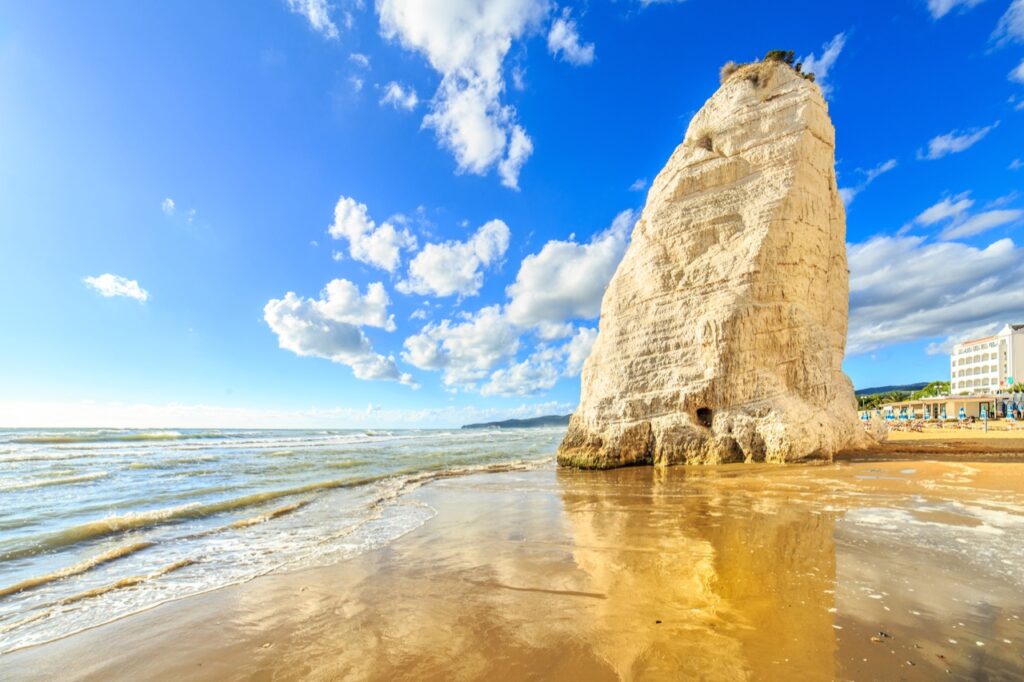
According to a legend, this rock embedded in the sand is nothing more than a young fisherman turned into stone by the sirens jealous of the love that the young man felt for Cristalda. The spell stops every 100 years and only for one night can the two young people return to love each other.
The beach of the Castle occupies a coastline of about 3 km, a magnificent expanse of golden sand that lights up from sunrise to sunset. Further north, in front of the rock of Sant’Eufemia, the beach of San Lorenzo stretches out, smaller and more peaceful, and after Punta Santa Croce the beach of Scialmarino begins.
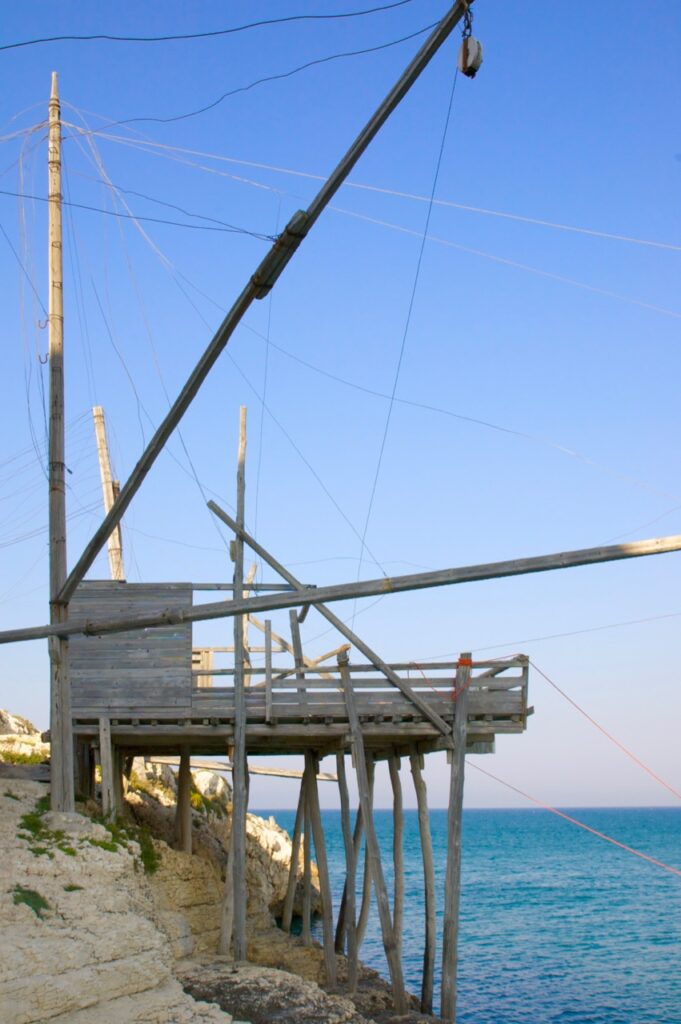
From several points along the coast and from the town it is possible to see the trabucchi, ingenious fishing tools typical of the middle Adriatic. The trabucco or tarocco or trabocco consists of slender legs anchored in the rock and a platform from which long arms that support a net depart. The net is lowered into the water through a complex system of winches. Today the trabucchi are protected by the Gargano National Park.
At the highest point of the city, 43 m above sea level, is the Frederick's castle from 1240 which houses a military barracks and for this reason inaccessible to tourists. An interesting example of Romanesque architecture is the cathedral, built in the 11th century where an ancient pagan temple probably once stood. The church preserves original columns and capitals and a valuable marble bas-relief from the 16th century. depicting the Deposition and a Madonna with child from 1581. In 1554 the terrible Turkish pirate Dragut Rais sacked the city and had hundreds of inhabitants beheaded on a stone still visible today. The stone is called "Chianca Amara" and is located at the intersection of via Cimaglia and via Boncompagni.

To visit the malacological museum, located in the historic center, which exhibits almost 15,000 different types of shells from all over the world. Just outside the city, in a marshy land protected by thick vegetation, there is an early Christian necropolis dating back to the 4th century. The site is known by the name "Necropoli della Salata" and shows burial chambers obtained in the caves.
Alberto Longo distanza 110 Km circa 90 min. in auto scopri la cantina


